Get A Free Quote

10 Best Vertical Lift Conveyors for Global Buyers

Choosing the right Verctical Lift Conveyor requires more than comparing prices and lifting heights. Global buyers must examine load stability, floor access, cycle speed, safety features, and after-sales support. A warehouse may need to move cartons between three levels, while a manufacturing plant may handle pallets weighing several tons. These are different applications.

Materials-handling engineer Robert E. Schmid explains, “A vertical conveyor succeeds when it moves products safely, repeatedly, and without interrupting the wider process.” His observation reflects practical experience. A compact machine can save valuable floor space, yet poor integration may create congestion around loading points. Small details matter. Guarding, sensors, controls, and emergency stops should be reviewed before purchase.

This guide presents ten leading vertical lift conveyor options for international buyers. Each selection considers construction quality, usable capacity, operating speed, maintenance access, and supplier reliability. It also recognizes regional differences in voltage, installation practice, spare-parts availability, and technical service. A conveyor that performs well in a dry warehouse may struggle in a cold, dusty, or humid environment.

There is no universal winner. That deserves attention. Some systems offer impressive throughput but require complex integration. Others appear simple but provide easier maintenance and lower long-term risk. Buyers should request layout drawings, test data, warranty terms, and references from comparable facilities. The final decision should match the product, building, workforce, and future growth—not just the catalog headline.
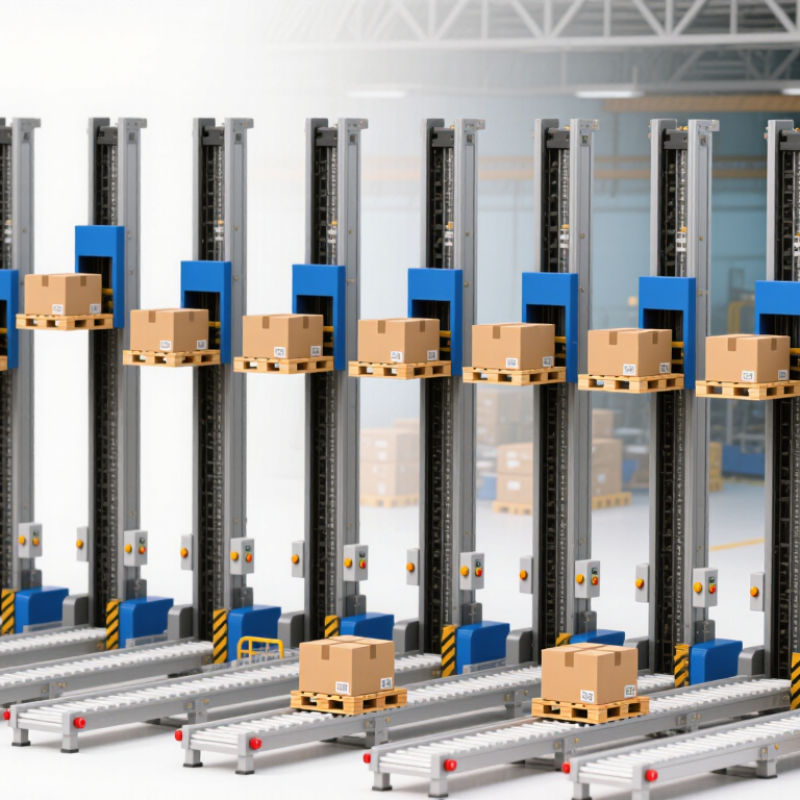
10 Best Vertical Lift Conveyors for Global Buyers

What Is a Vertical Lift Conveyor and How Does It Work?

A vertical lift conveyor is a material-handling machine that moves goods between different elevations. Unlike a sloping belt, it uses a compact vertical frame. A platform, belt, chain, or roller deck carries the load upward or downward. Guides keep the carrier aligned during travel. In warehouses, this design can connect mezzanines, production lines, and storage levels without requiring a long floor ramp.

The working cycle is straightforward. An operator or upstream conveyor places a carton on the carrier. Sensors check position, load presence, and door status. A motor drives the lifting mechanism through chains, belts, screws, or hydraulic components. The carrier stops at a programmed level, then transfers the item to the receiving conveyor. Interlocked gates help prevent access while the platform moves. Emergency stops and guarded pinch points are essential. They are not decorative features.

Selection requires more than comparing lifting height. Buyers should verify load dimensions, center of gravity, cycle rate, temperature, and available floor space. A 500-kilogram rating may not suit a tall, unstable container. That detail is often underestimated. Maintenance teams also need access to chains, rollers, sensors, and brakes. In real facilities, dust and uneven loading can reduce smooth operation. I would allow engineering tolerance instead of designing at the exact limit. The machine may work on paper, yet daily handling can expose weaknesses. Clear installation drawings, electrical standards, and local safety requirements should be reviewed before purchase.

Key Criteria for Evaluating Vertical Lift Conveyors

Key Criteria for Evaluating Vertical Lift Conveyors

Selecting a vertical lift conveyor starts with the load, not the brochure. Record product weight, dimensions, center of gravity, and packaging changes. A 50-kilogram carton behaves differently from a flexible bag. Measure lift height and required cycles per hour under real operating conditions. Peak demand matters more than average demand.

Check platform size, belt or roller design, and transfer accuracy. The conveyor should align with existing lines without forcing awkward handoffs. Review motor capacity, brake performance, guarding, emergency stops, and access controls. Safety features must suit the installation site and applicable local requirements. Ask for documented testing, maintenance instructions, and spare-part availability. Reliable suppliers should explain limitations clearly.

Footprint is important. So is noise. In a cold warehouse, lubricants and sensors may perform differently. In dusty areas, sealed components can reduce service problems. Calculate total ownership cost, including energy, inspections, downtime, training, and replacement parts. A low purchase price can hide expensive maintenance. One common mistake is choosing capacity from normal demand alone. A sudden seasonal surge may expose that error. However, oversized equipment can waste floor space and energy. No calculation is perfect. Recheck assumptions with operators who handle the conveyor daily. Their practical experience often reveals blocked access, difficult cleaning points, or controls that look simple but feel confusing.

10 Best Vertical Lift Conveyors for Global Buyers - Key Criteria for Evaluating Vertical Lift Conveyors

Comparison of common vertical lift conveyor configurations. Performance figures are typical engineering ranges and vary with product dimensions, duty cycle, layout, and applicable safety requirements.
No. Conveyor Configuration Typical Application Typical Load Range Typical Lift Height Typical Throughput Main Advantages Key Evaluation Criteria Best Fit
1 Reciprocating Vertical Conveyor Inter-floor transfer of cartons, totes, pallets, and containers 50–2,000 kg per load 3–20 m 20–60 loads/hour Flexible platform sizes; suitable for multiple floor levels; comparatively simple construction Platform dimensions, landing accuracy, guarding, brake system, and loading method Warehouses and production facilities with moderate transfer demand
2 Continuous Vertical Conveyor High-volume movement of cartons, trays, totes, or packaged goods 5–100 kg per item 3–15 m 300–1,500 items/hour Continuous flow; high throughput; limited operator involvement Product spacing, belt or chain design, transfer orientation, noise, and accumulation control Distribution centers and automated sorting lines
3 Vertical Reciprocating Conveyor with Roller Deck Pallet and heavy-unit-load transfer between dock, storage, and production levels 500–3,000 kg per load 3–12 m 10–40 loads/hour Handles rigid loads; integrates with powered roller conveyor systems Roller pitch, pallet condition, load center of gravity, deck strength, and safety interlocks Pallet warehouses, manufacturing plants, and distribution docks
4 Vertical Belt Conveyor Small cartons, parcels, bags, and unit products requiring gentle handling 1–50 kg per item 2–10 m 200–1,000 items/hour Smooth conveying; compact layout; suitable for variable product sizes Belt grip, product stability, belt tracking, cleaning access, and speed synchronization Parcel handling, food packaging, and light manufacturing
5 Vertical Screw Conveyor Vertical transport of powders, granules, pellets, and bulk solids Bulk material; commonly measured by mass flow 2–15 m Typically 1–100 m³/hour Enclosed conveying; dust-control potential; small footprint Material abrasiveness, moisture, temperature, sanitary design, and degradation risk Agriculture, chemicals, food ingredients, plastics, and minerals
6 Bucket Elevator High-volume vertical movement of grains, pellets, powders, and bulk materials Bulk material; commonly measured by mass flow 5–50 m or more Typically 5–200 m³/hour Efficient vertical lift; high elevation capability; relatively narrow footprint Bucket capacity, belt or chain selection, discharge efficiency, dust management, and wear resistance Grain handling, feed mills, cement, fertilizer, and bulk processing
7 Vertical Chain Conveyor Heavy-duty transfer of pallets, bins, fixtures, and industrial containers 100–2,500 kg per load 3–15 m 20–80 loads/hour High load capacity; robust in demanding environments; suitable for intermittent duty Chain working load, sprocket alignment, lubrication, corrosion protection, and impact loading Automotive, metalworking, fabrication, and heavy manufacturing
8 Spiral Vertical Conveyor Continuous elevation or lowering of cartons and packaged products 5–75 kg per item 3–12 m 200–1,500 items/hour Continuous infeed and discharge; can provide accumulation; connects different elevations smoothly Spiral diameter, product stability, pitch, accumulation pressure, and cleaning requirements E-commerce fulfillment, packaging, retail distribution, and food logistics
9 Vertical Lift Module Conveyor Automated storage and retrieval of trays, bins, tools, and small parts 5–500 kg per tray 3–20 m 20–100 retrieval cycles/hour High space utilization; controlled inventory access; supports goods-to-person workflows Tray dimensions, retrieval time, fire protection, software integration, and operator ergonomics Spare-parts storage, pharmaceuticals, electronics, and high-value inventory
10 Cleanroom Vertical Lift Conveyor Controlled-environment transfer of materials, trays, and sealed containers 10–500 kg per load 2–12 m 10–60 loads/hour Sealed surfaces; low-particle design options; supports controlled material flow Surface finish, cleanability, air leakage, materials of construction, validation, and contamination control Pharmaceutical, semiconductor, medical-device, and laboratory facilities
Core buying criteria: load and product dimensions, required lift height, throughput, duty cycle, available floor space, landing arrangement, safety guarding, controls integration, environmental conditions, maintenance access, local electrical requirements, and compliance with applicable regional standards.

10 Best Vertical Lift Conveyors for Global Buyers

10 Best Vertical Lift Conveyors for Global Buyers

Choosing the ten best vertical lift conveyors depends on product weight, height, speed, and available floor space. In practical warehouse projects, continuous bucket conveyors suit small cartons and steady flow. Reciprocating platform lifts handle heavier loads between clearly separated levels. Vertical belt conveyors work well when packages need gentle support during elevation. Cleated belt lifts help prevent boxes from sliding. Chain-driven lifts are useful for pallets, totes, and rigid containers. They need strong guarding and careful maintenance access. Compact spiral conveyors save floor space, but their curves may limit large products. Flexible screw lifts can move powders, although cleaning requirements demand close attention. Reliable sensors matter.

A good comparison should also include modular slat lifts and multi-column platform systems. Slat designs offer stable surfaces for irregular cartons. Multi-column equipment can support higher loads with controlled movement. For global buyers, check voltage compatibility, documentation, spare-part availability, and local service capability. Ask for load tests, noise data, emergency-stop details, and corrosion protection. Do not trust speed figures alone. A fast lift may create product jams at the transfer point. I have seen layouts fail because operators could not reach a blocked sensor safely. That detail is easy to miss. Confirm conveyor width with the largest package, not the average one. Review dust, temperature, and cleaning conditions before approval. A small design compromise can become a daily maintenance problem.

10 Best Vertical Lift Conveyors for Global Buyers

Representative throughput benchmarks for common vertical conveyor applications

The chart compares typical load-handling capacities measured in loads per hour. Actual performance varies with lift height, load size, conveyor speed, transfer time, safety requirements, and the number of entry and exit points. These values are general engineering benchmarks for preliminary global sourcing comparisons, not brand or supplier ratings.

Comparing Capacity, Safety, Speed, and Installation Requirements

The 10 Best Vertical Lift Conveyors for Global Buyers should be compared by capacity, safety, speed, and installation demands.

MHI’s 2024 Annual Industry Report found that 55% of supply chain leaders planned to increase technology investment. That shift makes vertical material flow more important in compact warehouses.

Capacity should match the real load, not the catalog maximum. A conveyor rated for 1,000 kilograms may perform poorly with uneven pallets, frequent starts, or off-center cartons.

Speed also needs context. A fast lift can create bottlenecks at scanning, packing, or discharge points.

For safety, buyers should verify guarding, emergency stops, interlocks, and access control against applicable standards, including ANSI/ASME B20.1 and ISO 12100 risk-assessment principles. OSHA guidance repeatedly emphasizes guarding moving parts and controlling pinch points.

Installation deserves equal attention. Measure ceiling height, floor strength, service clearance, power supply, and fire-system interference before ordering. One missed dimension can delay commissioning for weeks.

Tips:

Request tested throughput using your actual cartons, pallet weights, and cycle pattern. Ask for noise, energy, maintenance, and spare-parts data.

A factory acceptance test is useful, but it cannot reproduce every site condition. I would also allow extra capacity. Forecasts are often optimistic, and operators do not always load equipment perfectly.

Perfect comparisons are difficult. Reliability may matter more than peak speed.

How to Select the Right Vertical Lift Conveyor for Your Facility

Choosing the right vertical lift conveyor starts with your facility, not a product ranking. Measure floor height, available space, load weight, and required cycle time. A compact unit may suit cartons moving between two levels, while heavier pallets need stronger guides, platforms, and guarding. Confirm the conveyor’s rated capacity includes uneven loads and frequent starts.

Safety and maintenance deserve equal attention. Look for interlocked access doors, emergency stops, stable load transfer, and clear operator visibility. Ask for documented testing, installation requirements, and service guidance. In my experience, many selection errors come from measuring the conveyor alone. Leave room for maintenance access, electrical panels, and future adjustments. This detail is easy to miss.

Tips: Track the heaviest and widest load, not the average one. Compare hourly throughput with real peak demand. Check whether your floor can support dynamic loads. Request noise data if employees work nearby. A lift that runs smoothly during testing may perform differently after dust, temperature changes, and years of use. Review those conditions honestly before approving the specification.

crossmenu linkedin facebook pinterest youtube rss twitter instagram facebook-blank rss-blank linkedin-blank pinterest youtube twitter instagram