Get A Free Quote

China Top 10 Ceramic Ball Filler Manufacturers

China’s ceramic industry serves demanding markets, from petrochemical towers to water-treatment columns. This article introduces ten leading Chinese Ceramic Ball Filler manufacturers and the standards that separate reliable suppliers from attractive catalogues.

A Ceramic Ball Filler is not merely a round ceramic product. Its performance depends on chemical stability, crushing strength, porosity, surface texture, and dimensional consistency. Dr. W. David Kingery, a respected ceramic materials scientist, described ceramics as “inorganic, nonmetallic materials.” That simple definition matters here. It reminds buyers to examine material behavior, not only shape or price.

The manufacturers reviewed in this guide are considered through practical purchasing questions. Can the supplier provide recent test reports? Are alumina content and water absorption clearly stated? Does the factory control firing temperature and batch consistency? Small variations can affect pressure drop, packing density, and service life inside an operating vessel.

Visual inspection still has value. Uniform balls should show smooth surfaces, clean edges, and limited cracking. Yet appearance cannot prove long-term resistance. Laboratory data is essential. So are production records.

No ranking is permanent. Market capacity, export experience, certifications, and technical support can change. Some suppliers may excel in high-alumina products but perform less strongly in custom sizes. Others may offer flexible manufacturing but limited international documentation.

This guide therefore avoids treating “top” as a simple sales label. It focuses on evidence, application fit, and communication quality. Buyers should verify every specification before placing an order. That step feels slow. It can prevent costly replacement later.
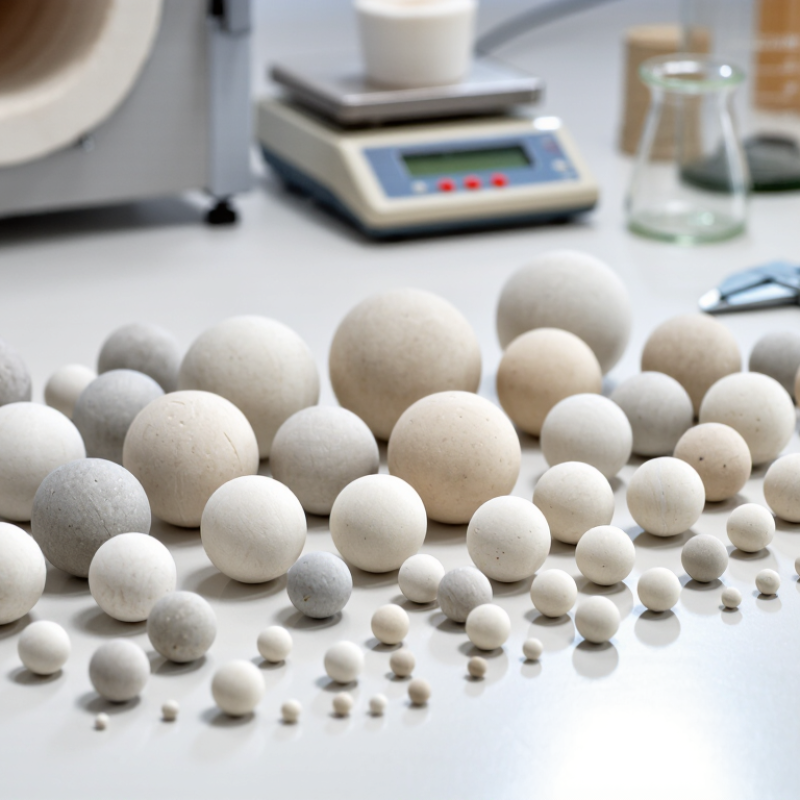
China Top 10 Ceramic Ball Filler Manufacturers

What Ceramic Ball Fillers Are and Where They Are Used

Ceramic ball fillers are shaped pieces made from materials such as alumina, silica, or zirconia. They are usually dense, chemically stable, and resistant to heat, pressure, and abrasion. Their smooth surfaces help fluids move through packed equipment with less obstruction. Porous grades provide additional surface area for catalyst support.

These fillers are widely used in fixed-bed reactors, distillation columns, absorption towers, and gas-treatment units. In reactors, inert ceramic balls can support catalyst layers and protect them from sudden liquid impact. They also help distribute gas and liquid more evenly. In packed towers, different sizes can improve flow distribution and reduce channeling. Some grades are used in filtration beds or thermal storage systems.

Selection requires practical judgment. Engineers should check temperature, pressure, chemical compatibility, crush strength, porosity, and particle size. A filler that performs well in a dry gas system may fail in a wet, acidic process. That detail is often underestimated. Larger balls may reduce pressure drop, but they can create poor contact between phases. Smaller balls improve contact, yet they may increase resistance and dust formation. Testing remains important, because laboratory data cannot fully represent vibration, thermal cycling, or uneven loading inside industrial equipment.

How China’s Ceramic Ball Filler Industry Has Developed

China’s ceramic ball filler industry has moved from low-cost shaping to application-focused production. Earlier factories mainly supplied standard inert balls for towers and reactors. Now, buyers request tighter diameter tolerance, lower water absorption, and controlled alumina content. This shift follows China’s expanding refining and chemical sectors. The China Petroleum and Chemical Industry Federation reported continued industrial growth in 2023, supporting demand for tower packing and catalyst-support materials.

A 2024 Grand View Research report estimated the global ceramic balls market at roughly USD 1.8 billion, with steady growth expected through 2030. Mordor Intelligence also identifies Asia-Pacific as the leading regional market, driven by refining capacity and process equipment investment. These figures include several ceramic-ball applications, not filler products alone. That limitation matters.

Chinese manufacturers have responded with automated pressing, tunnel-kiln firing, and batch-based quality control. Production teams commonly test bulk density, crushing strength, water absorption, and thermal shock resistance. In practical use, a well-made 25-millimeter ball should maintain its shape under hot gas flow and repeated loading. Small surface cracks can create dust and pressure-drop problems. They are easy to overlook.

Industry development is uneven. Large producers often provide traceable test records, while smaller workshops may still rely on visual inspection and irregular sampling. Buyers should compare laboratory results with site performance. Certification alone is not enough.

Criteria for Ranking China’s Top 10 Manufacturers

Ranking China’s top ceramic ball filler manufacturers requires measurable evidence, not showroom size or polished brochures. Production capacity should be verified through machinery records, monthly output, and delivery history. A factory shipping 500 tons monthly needs different controls from a small workshop. We also examine alumina content, bulk density, water absorption, crushing strength, and abrasion loss. ASTM C20 and ASTM C373 offer useful testing references for porosity, density, and water absorption. However, standards alone cannot prove stable performance.

Quality consistency receives the highest weight. We compare at least three recent batch reports and inspect particle size under actual operating conditions. ISO’s 2022 Survey recorded 1,265,216 ISO 9001 certificates worldwide, so certification is common, but it is not a ranking shortcut. Traceable raw materials, calibrated testing equipment, and retained samples matter more. Export records from UN Comtrade can support delivery claims, while response time and replacement procedures reveal practical reliability. Energy use also deserves attention. A manufacturer with efficient kilns may reduce production costs and emissions, but public carbon data remains limited in this sector. That weakness should be acknowledged. Our ranking therefore weights quality control at 30%, technical capability at 25%, delivery reliability at 20%, verified production capacity at 15%, and responsible manufacturing at 10%. Independent inspection, customer process trials, and transparent records can adjust the score when paperwork looks better than factory reality.

Profiles of China’s Top 10 Ceramic Ball Filler Manufacturers

China’s top ten ceramic ball filler manufacturers show a wide production range. Their profiles commonly include high-alumina balls, inert ceramic media, and structured packing components. Most factories offer alumina contents from 60% to 99%. This affects hardness, density, and chemical resistance. Mordor Intelligence estimates the global ceramic balls market will grow steadily through 2030, supported by refining, chemical processing, and environmental applications. However, market growth does not guarantee equal factory quality.

The strongest manufacturers usually maintain ball-milling, pressing, firing, and grading lines in-house. Their profiles also reveal practical differences in kiln temperature control, batch traceability, and inspection frequency. Buyers should request bulk density, water absorption, crushing strength, and size-tolerance records. A reliable supplier can provide recent test results, not only a polished catalogue. Export experience matters too. Packaging must protect sharp-edged media from moisture and impact. One weakness remains: public factory information is often incomplete. Rankings therefore need careful verification.

Tips: Compare three samples under the same operating conditions. Check alumina content with a third-party laboratory when specifications are critical. Ask for ISO documentation, inspection photographs, and replacement policies. A lower quotation may hide higher breakage rates. In my experience, small chips can increase pressure drop and shorten service life. The cheapest option is rarely the most predictable.

How to Choose the Right Chinese Ceramic Ball Filler Supplier

Choosing the Right Chinese Ceramic Ball Filler Supplier

When comparing China’s top ceramic ball filler manufacturers, start with your process requirements. Define the filler’s size, density, shape, and application temperature. A refinery bed may require low pressure drop and high crush strength. A chemical unit may need strong acid resistance and low water absorption. Do not accept general claims such as “premium quality” without test data.

Ask each supplier for recent inspection reports, production tolerances, and batch traceability. Check whether testing covers crush strength, abrasion loss, moisture, and chemical stability. Independent laboratory results are useful, but factory records also reveal daily consistency. Request samples from different production batches. One sample can look excellent. It may not represent routine output.

Production experience matters. Visit the facility remotely or in person, and inspect mixing, forming, drying, firing, and screening controls. Ask how rejected pieces are handled. Packaging needs attention too. Strong woven bags, inner liners, and clear labels reduce damage during ocean transport. Confirm pallet dimensions and loading photos before shipment.

Price alone can mislead. Compare usable volume, replacement frequency, delivery time, and technical support. A cheaper filler may create more dust or require earlier replacement. That cost appears later. Review payment terms, warranty language, and response times before signing. I have found that even careful buyers overlook moisture protection during storage. That mistake is avoidable, but supplier advice is not always complete. Leave room for verification.

China Top 10 Ceramic Ball Filler Manufacturers - How to Choose the Right Chinese Ceramic Ball Filler Supplier
Screening Position Anonymous Supplier Profile Primary Ceramic Filler Type Common Product Sizes Typical Al₂O₃ Content Water Absorption Typical Mohs Hardness Recommended Service Temperature Available Quality Documents Customization Capability Best Application Fit Selection Score
01 Supplier Profile 01 Inert alumina ceramic balls 3–76 mm 70–92% ≤5% 8–9 Up to approximately 1,500°C, subject to grade COA, particle-size report, chemical analysis, safety data sheet Size, packaging, and chemical composition Refinery beds, gas treatment, and catalyst support layers 9.2/10
02 Supplier Profile 02 High-alumina ceramic balls 3–100 mm 90–99% ≤3% 9 Up to approximately 1,600°C, subject to grade COA, ISO 9001 evidence, density report, inspection record High-purity grades and mixed-size loading plans High-temperature reactors and demanding chemical service 9.1/10
03 Supplier Profile 03 Alumina grinding and filler balls 0.5–60 mm 60–92% ≤5% 8–9 Up to approximately 1,500°C, subject to grade COA, bulk-density data, abrasion-loss report, size analysis Small-diameter sizes and custom blended distributions Mineral processing, ceramic slurry, and powder preparation 8.9/10
04 Supplier Profile 04 Low-silica inert ceramic balls 6–76 mm 65–90% ≤4% 8–9 Up to approximately 1,450°C, subject to grade COA, silica analysis, compressive-strength data, packing list Low-silica formulations and export packaging Hydrocarbon processing and applications sensitive to contamination 8.8/10
05 Supplier Profile 05 Porcelain and mixed-oxide ceramic balls 10–100 mm 45–75% ≤8% 7–8 Up to approximately 1,300°C, subject to grade COA, dimensional inspection, compressive-strength report Diameter selection and palletized export packing General support media, tower packing, and liquid distribution 8.5/10
06 Supplier Profile 06 High-strength activated alumina balls 2–8 mm 70–95% Application-dependent 8–9 Typically below 400°C in adsorption service COA, surface-area report, pore-volume data, crush-strength report Particle-size grading and moisture-controlled packing Drying, adsorption, compressed-air, and gas purification systems 8.7/10
07 Supplier Profile 07 Wear-resistant alumina ceramic media 1–50 mm 75–95% ≤4% 9 Up to approximately 1,500°C, subject to grade COA, wear-loss test, density report, dimensional inspection Special diameters, rounded profiles, and private-label-free packaging High-abrasion milling and slurry circulation systems 8.6/10
08 Supplier Profile 08 Structured ceramic packing balls 25–100 mm 40–70% ≤10% 7–8 Up to approximately 1,200°C, subject to grade COA, dimensions, voidage data, pressure-drop information Custom dimensions, surface texture, and loading configuration Absorption towers, scrubbers, and liquid-gas contact equipment 8.4/10
09 Supplier Profile 09 Refractory ceramic support balls 10–80 mm 45–85% ≤7% 7–9 Up to approximately 1,400°C, subject to grade COA, refractoriness data, compressive-strength report, batch traceability Layered-bed sizes and heat-treatment options Thermal equipment, kiln systems, and catalyst-bed support 8.3/10
10 Supplier Profile 10 General-purpose ceramic filler balls 6–76 mm 35–75% ≤10% 7–8 Up to approximately 1,200°C, subject to grade COA, size report, packing list, pre-shipment inspection support Standard grades, mixed containers, and flexible quantities Cost-sensitive tower packing and general industrial applications 8.1/10

Note: The technical ranges above represent commonly published industry specifications for ceramic filler and support balls. Actual values vary by formulation, firing process, particle size, and test method. Buyers should request a current certificate of analysis, representative samples, compressive-strength data, water-absorption results, and third-party inspection before placing an order.

crossmenu linkedin facebook pinterest youtube rss twitter instagram facebook-blank rss-blank linkedin-blank pinterest youtube twitter instagram