Get A Free Quote

China Top 10 PU Sandwich Panel Manufacturers?

Choosing among China’s leading Pu Sandwich Panel manufacturers requires more than comparing price lists. The panels may look similar in a catalog, yet differ in core density, joint fit, steel thickness, and documented thermal performance. On a cold morning, a poorly sealed joint can matter as much as the insulation core. Details matter.

The stakes are substantial. The 2024 Global Status Report for Buildings and Construction, published by UNEP and the GlobalABC, estimates that buildings and construction account for 32% of global energy demand and 34% of energy-related CO₂ emissions. The International Energy Agency has described energy efficiency as the “first fuel”; Executive Director Fatih Birol has used that phrase to emphasize its value. That principle is relevant to Pu Sandwich Panel selection, though it cannot replace product-level test evidence.

This guide compares ten Chinese manufacturers through practical criteria: production capability, product range, quality documentation, customization, export experience, and after-sales support. Buyers should request current test reports and check whether stated performance applies to the exact panel configuration they plan to order. A brochure is not a factory audit. Nor does a top-ten list prove that one supplier suits every project. Some comparisons remain imperfect; public data is uneven, and specifications can change. Treat the ranking as a starting point, then verify the details with each manufacturer.
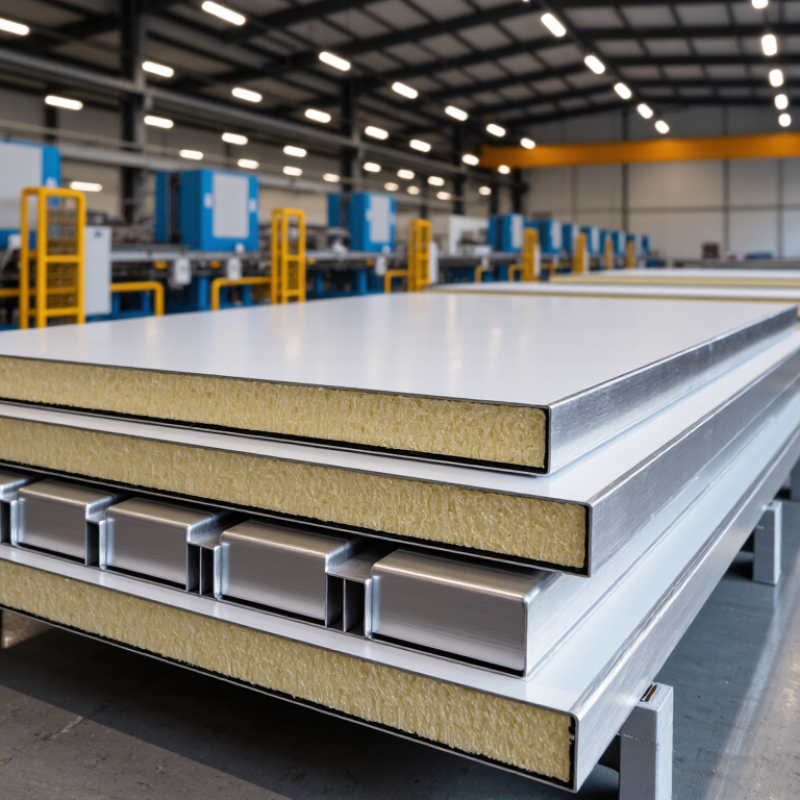
China Top 10 PU Sandwich Panel Manufacturers?

How PU Sandwich Panels Are Made and Used in China

In China, PU sandwich panels are commonly produced on continuous lines designed for steady output and consistent dimensions. Metal coil is unrolled, cleaned, and shaped into outer sheets. A liquid polyurethane mixture is then applied between the facings. It expands, bonds to the metal, and cures under controlled pressure. The finished panels are cut to length and checked for thickness, surface quality, and bond strength. Small process variations still matter.

These panels are used in cold rooms, food-processing areas, warehouses, and factory buildings. Their insulated cores help limit heat transfer, while the metal faces provide a durable enclosure. On a chilled-room project, for example, installers align panel edges and seal the joints to reduce air leakage. A neat panel alone is not enough. Poor sealing can undermine temperature control.

Buyers should compare core thickness, metal-face specifications, joint design, and documented fire-performance ratings for the intended application. Requirements can differ by project, so product data and local building rules need careful review. Cutting corners during installation is tempting, but it may create gaps or condensation problems later. Even well-made panels need sound detailing.

China’s PU Sandwich Panel Manufacturing Landscape

China’s PU sandwich panel manufacturing landscape is broad, with producers serving cold storage, industrial buildings, workshops, and commercial projects. A “top 10” list is most useful when it compares capabilities rather than treating rank as proof of quality. Some factories focus on high-volume standard panels; others handle custom lengths, finishes, or project-specific details.

Production quality depends on more than the visible metal surface. Buyers can ask how the polyurethane core is mixed, how panel thickness is checked, and whether bonding is inspected across the full panel. A clean cut edge, even foam distribution, and tight-fitting joints are practical details to examine. Small gaps matter. They can affect thermal performance and installation work.

Suppliers also differ in lead times, technical support, and testing documentation. Requesting sample sections and reviewing recent production records can help clarify what a factory can consistently deliver. No factory is best at everything. Specifications may look complete on paper, yet site conditions can expose missing details, such as corner treatments or fastener placement. Careful comparison of these points gives a more grounded view of China’s changing manufacturing landscape.

China’s PU Sandwich Panel Manufacturing Landscape

Typical thermal conductivity ranges for common sandwich-panel insulation cores (W/m·K)

Lower thermal conductivity generally means better insulation at the same thickness. PUR and PIR are commonly selected for insulated panels; actual values vary by product formulation, density, and test conditions.

Criteria for Assessing Leading Chinese Manufacturers

Assessing leading Chinese PU sandwich panel manufacturers starts with the panel, not a polished catalog. Request the declared core density, metal-skin thickness, coating type, and dimensional tolerances for the exact model you plan to purchase. Compare these details with test reports and production samples. Ask how bond strength and panel flatness are checked across a batch, not just on one showcase piece. Small differences matter. A warped edge can complicate installation.

Read fire and thermal performance claims carefully. Test results should match the panel construction and intended application; a certificate for a different thickness may offer little guidance. Check who performed the testing, when it was done, and whether the report identifies the materials tested. Ask for written quality-control procedures, too. Paperwork alone is not proof, but missing or inconsistent records deserve questions.

Factory capacity matters, but repeatability matters more. Look for batch inspection records, traceable material specifications, and clear packaging and delivery procedures. Speak with technical staff about joint details, cutting, and installation limits. Their answers should be specific, not rehearsed. If possible, inspect a sample under ordinary handling and compare its edges, surface finish, and bonding. No score is perfect. Some smaller suppliers may provide strong technical evidence, while larger operations can still vary between production runs.

Profiles of Ten Notable PU Sandwich Panel Manufacturers

The ten profiles below focus on manufacturing strengths rather than rankings or company names. A high-volume producer may offer standard panel widths, steady output, and shorter lead times. A customization-focused factory can adjust panel thickness and metal facings for unusual building dimensions. Some manufacturers operate continuous production lines, which can help maintain consistent panel geometry across large orders. Others specialize in cold-storage panels, where tight joints and controlled core density matter. Details count.

A fire-performance specialist should provide clear, product-specific test documents; a label alone is not enough. Cleanroom panel makers may offer smooth, easy-to-clean surfaces and carefully finished edges. Smaller regional producers can suit projects needing modest quantities or nearby technical support. Export-oriented factories often pay close attention to protective wrapping and loading plans, though buyers should confirm packaging details. Integrated producers may form metal facings in-house, helping coordinate panel dimensions and trims. A technically strong supplier can explain installation limits and provide useful drawings, not just a price. Still, factory claims deserve checking: request current test reports, inspect sample joints, and compare specifications line by line. A polished brochure cannot show how panels will perform on a damp, windy jobsite.

Comparing Product Range, Certifications, Capacity, and Export Reach

Comparing China’s top PU sandwich panel manufacturers requires more than counting product models. Check whether each supplier offers varied panel thicknesses, metal facings, joint profiles, and made-to-order lengths. Ask for technical data on core density, thermal conductivity, and fire performance. Specifications should match the intended building, not just a sales brochure. Small details matter.

Certifications need careful review. Confirm the issuing body, validity dates, and whether the document covers the factory, product, or management system. A certificate alone does not prove every panel batch meets the same standard. Request recent test reports and sample inspection records. Then compare production capacity with realistic delivery schedules. Published annual output may describe installed machinery, not current usable capacity. Ask about shift patterns, quality checks, and how defects are handled.

Export reach is also practical, not merely a list of destination countries. Look for experience with export packing, moisture protection, shipping documents, and clear technical communication. Request references for similar panel specifications and markets where possible. A factory with broad reach may still be a poor fit for a small, urgent order. Comparisons have limits. Recheck claims directly, and note where evidence is missing rather than treating every supplier’s figures as equal.

China Top 10 PU Sandwich Panel Manufacturers? – Comparing Product Range, Certifications, Capacity, and Export Reach Supplier-neutral comparison guide: ten key areas to assess when shortlisting Chinese manufacturers
No. Comparison area What can be compared reliably Evidence to request from each manufacturer Important qualification
01 Panel core and product range PU and PIR insulated panels are used for roofs, walls, cold rooms, and other building-envelope applications. Available profiles and configurations differ by production line. Current product catalogue, technical data sheets, cross-sections, and confirmation of the exact core material offered. Do not treat PU and PIR as interchangeable; verify the product composition and performance for the specific model.
02 Panel dimensions and options Panel thickness, effective cover width, metal facings, joint design, coatings, and cut-to-length options are product-specific. Dimension schedule, available tolerances, facing specifications, coating details, and a written confirmation of custom-order limits. Compare like-for-like configurations; different facings or joints can change performance and price.
03 Thermal performance Thermal transmittance depends on core type, thickness, joints, facings, and test method—not thickness alone. Test reports stating the tested panel construction, declared thermal conductivity or U-value, and applicable test standard. Check that the report covers the quoted panel configuration rather than a different thickness or product family.
04 Fire performance Fire reaction and fire-resistance results are specific to the tested product assembly and the relevant classification system. Current third-party test or classification reports, including product identification, assembly details, and report validity. A core-material description or a general fire claim is not a substitute for a product-specific report.
05 Quality-management certification ISO 9001 concerns an organization’s quality-management system; it does not, by itself, certify the performance of every panel. Certificate number, issuing and accreditation body, certified legal entity, scope, sites covered, and expiry date. Check the certificate against the actual manufacturing entity and facility supplying the order.
06 Product and market approvals Applicable approvals depend on the destination market, intended use, product specification, and project requirements. Relevant declarations, test reports, listings, or approvals for the exact product and destination market. CE marking applies only where the relevant EU rules and product requirements apply; FM approval is product- and system-specific.
07 Production capacity Capacity figures are not directly comparable unless their units, operating schedule, product mix, and calculation basis are stated. Rated and recent actual output, number of operating lines, shift pattern, product mix, and lead-time commitment. Annual capacity claims may describe theoretical output and should not be assumed to equal available order capacity.
08 Manufacturing capability Line configuration, profiling equipment, foaming process, cutting capability, and in-process inspection affect the products a plant can supply. Facility details, production-process overview, inspection plan, calibration records, and recent product samples. Confirm whether the quoted product is made at the stated facility or sourced from another producer.
09 Export reach and logistics Export suitability depends on destination-specific documentation, packaging, shipping arrangements, and experience with the required delivery terms. Recent redacted export documents, destination references, packaging specification, port options, and Incoterms quotation. Past shipments to a region do not establish compliance with every local building code or project specification.
10 Commercial and technical verification Warranty, minimum order quantity, sample availability, production lead time, payment terms, and after-sales support vary by supplier and contract. Written quotation, contract terms, warranty conditions, approved drawings, sample approval process, and named technical contact. Confirm all specifications and performance requirements in the purchase documents before production begins.
Accuracy note: This table is a supplier-neutral evaluation guide, not a verified ranking of ten named manufacturers. Manufacturer-specific certifications, capacities, product ranges, and export records should be checked against current documents from each supplier; no company or brand data is asserted here.
crossmenu linkedin facebook pinterest youtube rss twitter instagram facebook-blank rss-blank linkedin-blank pinterest youtube twitter instagram