How to Choose LED EM Lights in 2026
Choosing Led Em Lights in 2026 means looking beyond brightness and price. A dependable emergency light must suit the building, expected outage conditions, and people using the space. Start by identifying where each fixture will be installed: a corridor, stairwell, work area, or exterior entrance. Each location creates different demands for coverage, mounting, and protection from dust or moisture. Details matter.
Compare usable light output, beam pattern, backup runtime, and recharge time. A high lumen figure may sound impressive, but it does not guarantee even illumination across a long hallway. Check whether the unit offers maintained or non-maintained operation, and confirm that its battery can support the intended duration. Battery type, replacement availability, and operating temperature also deserve attention. These details are easy to overlook. They matter later.
Reliable selection also means checking product documentation, applicable local requirements, and recognized safety certifications for the intended market. Ask suppliers for clear specifications, warranty terms, installation guidance, and a practical method for routine testing. During a site review, note mounting height, nearby obstructions, and the route occupants would actually take during an outage. A drawing can miss a doorway shadow. I would not choose the brightest model automatically; that shortcut can leave important areas poorly lit. Nor should a low price outweigh serviceability or documented performance. The right choice is the one whose verified capabilities match the real site, with enough evidence to reassess the decision when conditions change.
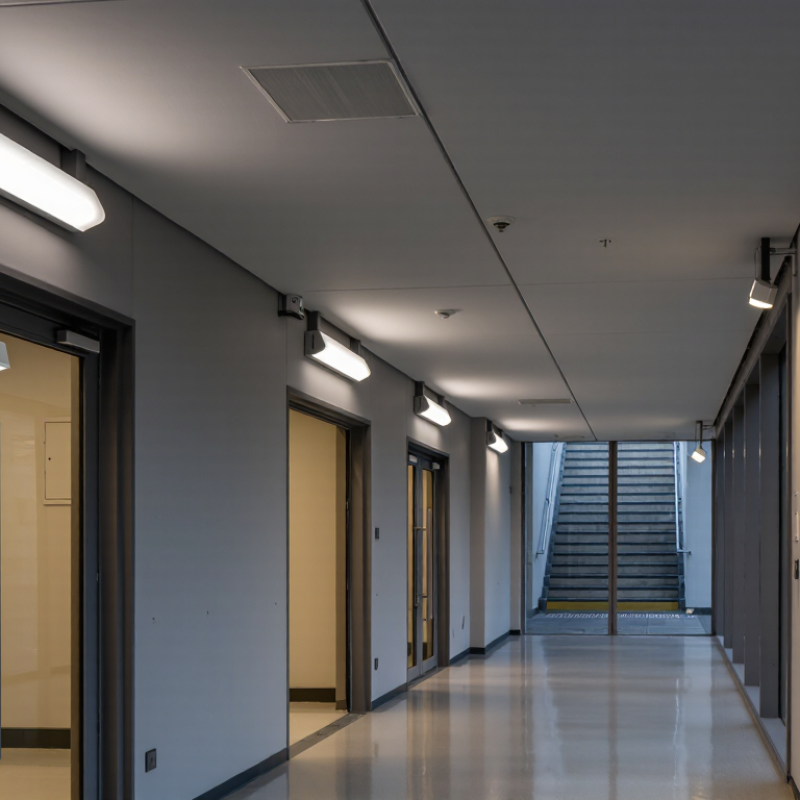
Define LED EM Lights and Their Role in Life-Safety Systems
LED EM lights are LED emergency luminaires designed to provide light when normal power fails. “EM” commonly means emergency; the fixture usually includes an LED source, backup battery, charging circuit, and a way to detect power loss. Some systems use a central backup supply instead. When the building’s regular lighting goes dark, these fixtures help make paths, stairs, and exit approaches visible. That matters in smoke, confusion, or a sudden blackout. A narrow beam can leave a landing dim, even when the fixture itself appears bright.
Their role in life-safety systems is practical: support safer movement toward an exit and reduce dark areas along the route. They do not replace clear exit signs, alarms, or an evacuation plan. Look at where light falls, not only at the lumen figure. A doorway, stair tread, and corridor corner each need attention. Small details matter.
For a 2026 selection, check battery type, rated emergency runtime, charging status indicators, and whether the unit can be tested as installed. Follow the applicable local requirements and the manufacturer’s documented instructions. A monthly indicator check may catch a fault, but it does not prove the battery will perform for its full rated duration. That assumption is easy to make. It is not always safe. Testing and maintenance records help reveal weak batteries, blocked lenses, or fixtures aimed at the wrong spot.
Check UL 924 Listing and NFPA 101 Compliance Before Purchase
LED emergency lights can reduce routine energy use, but performance during an outage matters more. Before buying, verify that the exact model is listed to UL 924, the safety standard for emergency lighting equipment. A general “UL compliant” claim is not the same as a verifiable listing. Match the model number, battery, and operating mode to the certification record. Paperwork matters.
NFPA 101 (2024 edition) sets measurable egress-lighting thresholds: initially, at least 1 foot-candle average and 0.1 foot-candle minimum. After 90 minutes, the minimum is 0.06 foot-candle, with a 0.6-foot-candle average. Use photometric test reports to check these figures, not lumen claims alone. The U.S. Department of Energy’s 2022 U.S. Lighting Market Characterization estimated that LEDs made up nearly half of installed U.S. lighting in 2020. That adoption figure shows the technology’s reach, not code compliance.
Ask for the UL 924 listing, battery test results, and photometric data. Review results at your actual mounting height and corridor width. NFPA requirements can depend on adopted code editions and local authority decisions, so confirm both before purchase. One easy mistake is testing an empty room, then installing around shelving or signs. Real spaces are messy.
Size Battery Capacity for NFPA 101’s 90-Minute Runtime
When choosing LED emergency lights, size the battery for the required 90-minute operation, not just the fixture’s normal running time. NFPA 101 requires emergency illumination for at least 90 minutes in applicable situations; confirm the edition and requirements adopted by your local authority. A small corridor and a broad stairwell can place very different demands on the system.
Start with the emergency-mode load in watts, including lamps and control components. Multiply that load by 1.5 hours to estimate energy needs, then account for driver losses and the battery manufacturer’s discharge data.
For example, a 12-watt load needs 18 watt-hours before adjustments. Do not treat that figure as the final battery rating. Voltage, temperature, battery age, and discharge rate all affect usable capacity. Leave margin.
Check the actual product documentation and test the installed unit under realistic conditions. A cold utility room or an aging battery can reduce runtime.
Keep records of test dates and results; they help reveal gradual capacity loss. A spreadsheet can look precise and still miss a real-world detail. That is worth admitting.
When conditions are uncertain, have a qualified professional verify the load calculation and selected battery capacity.
Match Light Output to NFPA 101’s 1-Foot-Candle Initial Average
How to Choose LED EM Lights in 2026
NFPA 101 sets a measurable target for emergency lighting: an initial average of at least 1 foot-candle at floor level, with no point below 0.1 foot-candle. That average equals about 10.8 lux. After 90 minutes, the required average falls to 0.6 foot-candle, and the minimum falls to 0.06. Check the edition adopted for your project, since requirements and approvals can vary.
Do not select a fixture by its lumen rating alone. Lumens describe total light leaving the fixture, not the light reaching a stair tread or corridor floor. Compare independent photometric files, such as IES LM-79 test data, then model the actual mounting height, spacing, optics, and wall reflectance. A narrow beam can leave dark gaps between fittings. A glossy floor can also produce glare rather than useful visibility. That is not enough.
Choose output that meets the floor-level target across the whole route, including corners and landings. Then verify both initial and 90-minute performance under the intended backup-power conditions. It is tempting to stop once the average passes; that shortcut deserves a second look. NFPA 101’s minimum-point requirement matters just as much for a person navigating a dim, unfamiliar exit path. Document the test results and adjust spacing or distribution where readings fall short.
Compare Mounting, Testing, and Maintenance Features for 2026
Choosing LED emergency lights in 2026 means looking beyond brightness. Mounting affects both coverage and service access. A wall-mounted unit may suit a narrow corridor, while a ceiling-mounted fitting can spread light across an open room. Check the installation height, beam direction, and clearance around the housing. A ladder should not be needed just to read an indicator or reach a test control. Small details matter. A tidy fit can still leave a dark patch near a doorway.
Testing features deserve close comparison. Some units use a manual test button; others run automatic checks and display a status indicator. Automatic testing can save time, but staff still need to understand warning signals and record faults. Check whether the test method suits the site’s routine and the manufacturer’s instructions. A green indicator is useful, but it is not a substitute for checking that the light actually works. That part is easy to assume.
Maintenance can shape long-term value as much as the purchase price. Look for accessible batteries, clear replacement guidance, and components that can be inspected without dismantling the fitting. Keep a simple log of tests, faults, and repairs. It is tempting to compare models by lumen output alone. That is an incomplete comparison, and I would reconsider it whenever upkeep seems awkward. A practical choice is one people can inspect and maintain consistently.