How to Choose Poultry Slaughtering Equipment
Choosing poultry slaughtering equipment is a production decision, not a catalogue exercise. The right setup must match bird size, daily throughput, available floor space, staffing, and the products a plant intends to make. A line that looks efficient on paper may create bottlenecks at scalding, defeathering, or chilling. Small details matter: conveyor spacing, cleanable surfaces, water use, and access for routine maintenance.
Market data helps explain why careful planning matters. The OECD-FAO Agricultural Outlook 2024–2033 identifies poultry as a major contributor to projected growth in global meat consumption. USDA Foreign Agricultural Service reports, including Livestock and Poultry: World Markets and Trade, track production, trade, and consumption across major markets. These sources describe a changing industry, but they do not select equipment for an individual facility. That requires matching verified capacity claims with operating conditions and technical support.
Start with the process, not the sales brochure. Ask suppliers for documented throughput, utility requirements, installation needs, and cleaning procedures. Check whether spare parts and trained service technicians are realistically available. A fast machine is not automatically a productive one. Downtime is costly. Even a minor mismatch between line speed and chilling capacity can disrupt an entire shift. No specification sheet can capture every plant’s reality; sometimes the first plan needs revision. A careful comparison of poultry slaughtering equipment should therefore weigh performance, reliability, hygiene design, and long-term service—not purchase price alone.
Assess Your Poultry Processing Needs and Production Scale
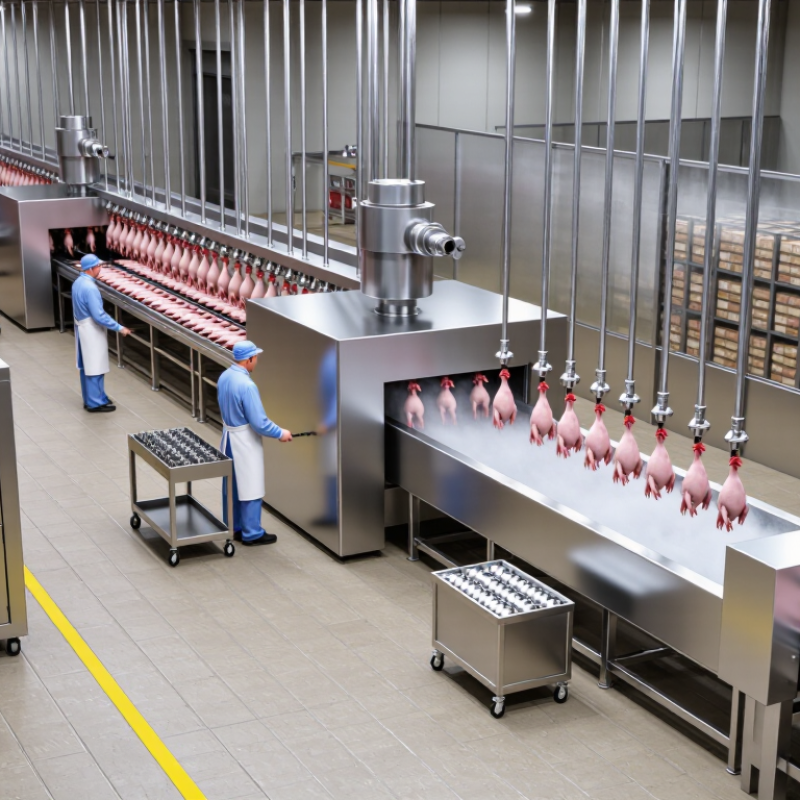
Choosing poultry slaughtering equipment starts with measuring the work, not selecting a machine. Record average and peak birds per hour, bird-weight range, daily operating hours, and planned cleaning time. A line handling 500 birds per hour has different needs from one handling 5,000. Small details matter.
The FAO’s 2022 production data put global poultry-meat output at roughly 142 million tonnes.
USDA’s Poultry Slaughter 2023 report recorded more than 9 billion broilers slaughtered in the United States.
These figures show why processing capacity varies widely. They do not, by themselves, tell you what one facility needs. Match equipment capacity to your own flock size, product mix, and realistic shift schedule.
Map each stage, from live-bird handling through chilling and packing. Check that the slowest station will not bottleneck the line, and confirm that chilling space can keep pace during peak runs. Peak days are different. Leave room for maintenance, staff breaks, and uneven bird sizes; rated capacity rarely reflects every shift. A modest line with dependable changeovers may suit a growing operation better than equipment sized for an optimistic forecast. Recheck the numbers after a trial run. Some assumptions will be wrong.
Match Equipment Capacity to Facility Layout and Workflow
How to Choose Poultry Slaughtering Equipment
Match Equipment Capacity to Facility Layout and Workflow
When selecting poultry slaughtering equipment, rated output is only a starting point. A line sized for peak volume can overwhelm a small room, while a modest system may create queues during busy shifts. Measure usable floor space, doorway widths, ceiling clearance, and distances between processing stations. Small details matter.
Map the workflow from receiving to chilling, then mark where workers, containers, and product move. Keep wet operations separate from clean handling areas, and leave room to wash equipment without blocking passages. A poorly placed conveyor can force awkward turns or repeated lifting. That is tiring.
Compare equipment capacity with realistic hourly throughput, staffing, sanitation breaks, and expected downtime—not an ideal uninterrupted run. Request footprint drawings and utility requirements, then check them against the facility before ordering. Paper layouts can look efficient but feel cramped once hoses and carts are in place. Build in service access and some flexibility; actual shift conditions may reveal problems the plan missed.
Compare Operating Costs, Maintenance, and Supplier Support
How to Choose Poultry Slaughtering Equipment
Compare operating costs beyond the purchase price. Ask suppliers to estimate electricity, water, labor, and consumables per 1,000 birds at your expected line speed. Then test those estimates against your own shift records. The European Commission’s 2019 Best Available Techniques reference document for the food, drink, and milk industries assesses slaughtering performance using activity-specific indicators, including water and energy use. That matters: a quoted cost per bird means little unless product mix, throughput, and cleaning cycles match your plant.
Maintenance can quietly erase a low purchase price. Request a written schedule for blade changes, lubrication, inspection, and replacement parts, with labor hours and expected downtime. Check whether common components are stocked locally and how quickly a technician can respond. Ask for a sample service log, not just a promise. Details matter. A brief stoppage during peak production can affect an entire shift, so compare projected maintenance cost per operating hour as well as annual service fees.
Supplier support should include operator training, troubleshooting guidance, and clear escalation contacts. Get response-time commitments in writing, and ask how support works outside normal business hours. Compare at least two references from plants with similar capacity. Be cautious with projected savings that lack assumptions; they may not survive real cleaning routines or staffing gaps. My own comparison would still leave room for doubt: maintenance estimates often look cleaner on paper than on a wet factory floor.
How to Choose Poultry Slaughtering Equipment
Compare estimated operating costs per 1,000 birds for three generic equipment configurations. The figures are illustrative planning estimates in USD, not supplier quotes. They assume comparable throughput and exclude equipment purchase, financing, and building costs; actual costs vary with local wages, utility prices, line utilization, and maintenance practices.
When comparing suppliers, confirm spare-parts availability, technician response times, operator training, warranty coverage, and access to preventive-maintenance support. Request itemized operating-cost estimates based on your expected throughput and local utility and labor rates.