Get A Free Quote

How to Choose a Real-Time Monitoring Sensor?

A Real-Time Monitoring Sensor turns changing physical conditions into data people can act on. It may track temperature inside a vaccine refrigerator, vibration on a pump, or humidity in a greenhouse. The right choice depends on what must be measured, how quickly readings are needed, and where the sensor will operate. Small details matter.

McKinsey’s 2021 report, “The Internet of Things: Catching up to an accelerating opportunity,” estimates that IoT could generate $5.5 trillion to $12.6 trillion in annual economic value by 2030. That figure covers the broader IoT ecosystem, not sensors alone. Still, it shows why dependable sensing and timely data matter. IoT pioneer Kevin Ashton described the underlying idea in RFID Journal: “If we had computers that knew everything there was to know about things—using data they gathered without any help from us—we would be able to track and count everything, and greatly reduce waste, loss and cost.”

For buyers, that promise depends on practical choices: measurement range, accuracy, response time, power, connectivity, and installation conditions. A sensor that performs well in a clean laboratory may drift in a hot, dusty plant room. Calibration records and maintenance access deserve attention, too. They are easy to overlook. No specification sheet can predict every field condition, and that uncertainty should be part of the decision. This guide examines how to compare sensor types, verify performance claims, and match a Real-Time Monitoring Sensor to the demands of its actual application.
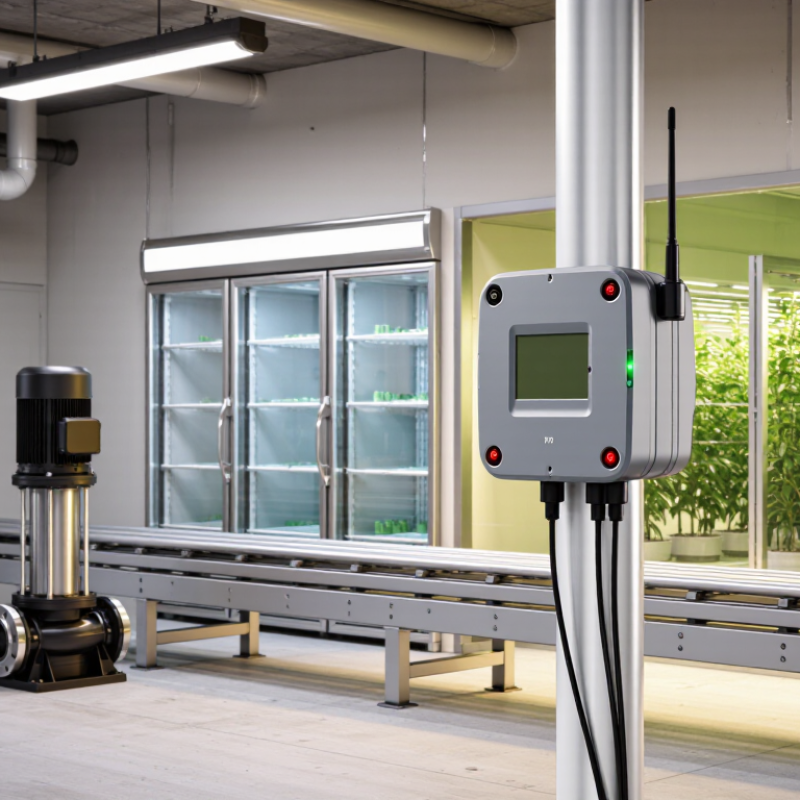
How to Choose a Real-Time Monitoring Sensor?

Define the Monitoring Requirements and Measurement Goals

A real-time sensor should answer a specific operational question, not simply produce a steady stream of numbers. Are you detecting a temperature excursion, tracking energy use, or triggering maintenance? Define the measured variable, operating range, acceptable error, and response time before comparing devices. For a chilled-water pipe, for example, a five-second update may be useful; a slow monthly trend cannot reveal a brief spike. Start with the decision. The IEA’s Energy Efficiency 2023 report says industry accounts for about 37% of global energy use, making reliable process measurements consequential. But that figure does not tell you which measurement your site needs.

Write down where the sensor will sit and what it will face: dust, vibration, washdowns, heat, or changing airflow. Specify the required sampling interval, data retention, alarm threshold, and how readings will reach operators. Check calibration needs and uncertainty across the full operating range, not just at room temperature. A useful trial compares sensor readings with a trusted reference under actual site conditions. Keep a record of drift. It is easy to overlook installation details; a poorly placed sensor can report precise-looking values that represent the wrong part of the process. Revisit the assumptions after deployment, especially when operating conditions change.

Identify Sensor Types Suitable for Real-Time Monitoring

Real-time monitoring depends on what changes, how quickly it changes, and where the sensor sits. For temperature, resistance temperature detectors suit stable, precise readings, while thermocouples tolerate hotter environments and rapid shifts. Thermistors respond quickly over narrower ranges. Pressure transducers track changes in pipes or vessels, and accelerometers reveal vibration from rotating equipment. A loose mounting can distort those readings. Small detail.

For air quality, electrochemical sensors can detect specific gases, while nondispersive infrared sensors measure gases such as carbon dioxide. Optical particle sensors estimate airborne dust, but humidity may affect their readings. Ultrasonic or radar sensors can monitor tank levels without touching the liquid. Flow sensors vary: thermal types work well with gases, while magnetic types suit conductive liquids. No type fits every installation.

Check the sensor’s response time against the process. A reading every second is not useful if the sensor takes minutes to settle. Consider temperature limits, moisture, vibration, cable length, and cleaning access. Review calibration needs and how the device reports faults, not just its advertised accuracy. A practical trial beside a reference instrument can expose drift or awkward placement. Still, test it. In a crowded machine room, even a technically suitable sensor may be hard to service.

How to Choose a Real-Time Monitoring Sensor?

Identify sensor types suitable for real-time monitoring by comparing representative response times. Lower values indicate a faster response.

These values are illustrative examples, not fixed specifications. Actual response depends on sensor design, packaging, installation, and measurement conditions. Check the relevant datasheet and response-time definition for your application.

Compare Accuracy, Response Time, and Data Output

A real-time monitoring sensor should match the conditions you need to measure, not just display an impressive accuracy figure. Check the stated tolerance and the range where it applies. A sensor may be accurate near room temperature but less reliable in a hot, damp enclosure. Look for calibration intervals and test methods, too. A quick comparison against a trusted reference can reveal drift. Small errors matter.

Response time describes how quickly a sensor reflects a change. It is not always the same as the time between readings. For a fast pressure spike, a slow sensor may miss the peak entirely. For gradual changes in a storage room, a few seconds of delay may be acceptable. Check the sensor’s response specification and the system’s sampling rate together. Faster is not automatically better; it can add noise and create false alarms.

Data output affects how useful readings are after measurement. Confirm whether the device provides raw values, processed averages, timestamps, and clear units. A one-second average can hide a brief event. Check the output format and update interval against your logging or control system. A sample reading on a bench can help expose missing fields or odd delays. This step is easy to skip, and sometimes the documentation leaves questions unanswered.

How to Choose a Real-Time Monitoring Sensor? — Compare Accuracy, Response Time, and Data Output

Sensor Type Typical Accuracy Typical Response Time Common Data Output Best Suited For Key Consideration
Pt100 RTD IEC Class A tolerance: ±(0.15 + 0.002 × |t|) °C, where t is temperature in °C About 0.5–10 seconds, depending on probe construction, sheath, and airflow or immersion Resistance signal; commonly converted by a transmitter to 4–20 mA, 0–10 V, or a digital interface Stable, accurate temperature monitoring across industrial processes Requires suitable excitation and lead-wire compensation; probe installation affects response time.
Type K Thermocouple IEC Class 1 tolerance: ±1.5 °C or ±0.004 × |t| °C, whichever is greater About 0.1–5 seconds for exposed or small probes; larger sheathed probes respond more slowly Low-level millivolt signal; a measurement device needs cold-junction compensation Wide temperature ranges and applications where fast response or ruggedness matters Accuracy depends on the thermocouple grade, extension wiring, reference-junction measurement, and calibration.
NTC Thermistor Typically about ±0.1–0.5 °C for calibrated assemblies over a specified, limited range About 0.2–5 seconds, depending on bead or probe size and mounting Resistance signal, usually measured with a divider or dedicated interface and converted to temperature Compact equipment and applications needing high sensitivity over a narrow temperature range Resistance changes nonlinearly with temperature; calibration and linearization are often needed.
Digital Temperature IC Commonly about ±0.1–0.5 °C over a specified operating range; check the device specification Typically tens to hundreds of milliseconds per conversion, depending on settings and device Digital interfaces such as I²C or SPI; some devices provide a digital alarm output Embedded systems and distributed monitoring where direct digital integration is useful Conversion time, update rate, self-heating, and the sensor’s location on the circuit board can affect readings.
Infrared Temperature Sensor Often specified around ±1 °C or ±1% of reading; actual performance varies by model and conditions Typically about 0.1–1 second, depending on the sensor and configured averaging Analog voltage or current, or digital output such as I²C or a serial interface Non-contact measurement of moving, hot, or inaccessible surfaces Emissivity, field of view, target size, distance, and obstructions can significantly affect accuracy.

Note: These are representative ranges, not guarantees. Verify the sensor’s datasheet, operating range, calibration, installation, and measurement-chain specifications. Response time depends strongly on probe design and mounting; accuracy figures are not directly comparable unless measurement conditions are the same.

Assess Operating Conditions and System Compatibility

A real-time monitoring sensor must suit the place where it will operate, not just the measurement listed on its data sheet. Check the full temperature range, humidity, vibration, dust, and any exposure to cleaning fluids. A sensor near a warm motor may face sharp temperature swings, while one mounted on a pipe may receive constant vibration. Small details matter. Confirm that the sensing element responds quickly enough to capture changes your process can act on. Brief spikes can disappear in averaged readings. Also consider access for inspection and calibration; a difficult installation can make routine checks less reliable.

Compatibility matters just as much. Compare the sensor’s output type, supply voltage, connector, and communication protocol with the existing controller or monitoring platform. Confirm cable length and signal limits, especially when the sensor sits far from the control cabinet. A neat specification sheet can still mislead if it describes ideal conditions rather than your actual setup. Test the proposed sensor in a representative location when possible, and check readings against a trusted reference. Keep a record of the baseline. I would not assume that two sensors with the same range behave identically under real operating conditions. A little uncertainty remains until the system is tested.

Evaluate Calibration, Maintenance, and Long-Term Reliability

How to Choose a Real-Time Monitoring Sensor?

Calibration is not a box to tick during installation. Check the sensor against a suitable reference under the conditions it will actually face. Temperature swings, dust, vibration, and humidity can shift readings over time. Small shifts matter. Record the initial reading, calibration date, reference instrument, and any adjustment. These details make later comparisons useful. Follow the manufacturer’s calibration interval, then refine it using drift records and operating conditions. A fixed schedule may be convenient, but it can miss changes in a harsh environment. No checklist catches everything.

Maintenance should be practical enough to happen regularly. Inspect connectors for corrosion, clear dust from sensor openings, and look for condensation or damaged cables. Compare readings with a trusted reference or a nearby instrument when possible. Keep a simple log of cleaning, calibration, faults, and response time. Long-term reliability means more than staying online; a sensor can transmit steadily while reporting values that have slowly drifted. Track repeatability and recovery after power interruptions, too. Replacement plans deserve attention before a failure occurs. Spare units can help, but they may need matching calibration. That detail is easy to overlook. When readings affect important decisions, investigate unexpected changes rather than smoothing them away.

crossmenu linkedin facebook pinterest youtube rss twitter instagram facebook-blank rss-blank linkedin-blank pinterest youtube twitter instagram