How to Choose the Right Rubber Bushes?
Choosing the right Rubber Bushes can determine how safely and comfortably a vehicle or machine performs. These small components absorb vibration, limit unwanted movement, and protect connected parts from repeated impact. A bush that looks simple may carry significant loads every day.
The correct choice depends on more than outer size. Material hardness, inner diameter, sleeve design, temperature range, and exposure to oil or water all matter. Rubber compounds behave differently under heat, compression, twisting, and constant vibration. A soft bush may improve comfort, but it can allow excessive movement. A harder option may improve control, yet transmit more noise into the cabin or frame.
Measure carefully.
Start with the original part, but do not rely on appearance alone. Check the vehicle or equipment specifications, mounting position, load direction, and service history. Uneven wear can reveal misalignment, overloading, or a worn nearby component. Experienced technicians often inspect washers, bolts, brackets, and sleeves before installation. That step is easy to skip.
It should not be.
Reliable selection combines manufacturer guidance, practical inspection, and realistic operating conditions. There is no universal bush for every application. Even a reputable replacement can fail early if it is pressed incorrectly or tightened at the wrong suspension height. This guide explains the key factors behind a confident choice, while recognising that field conditions are rarely perfect. A careful decision reduces noise, premature wear, and unnecessary repair costs.
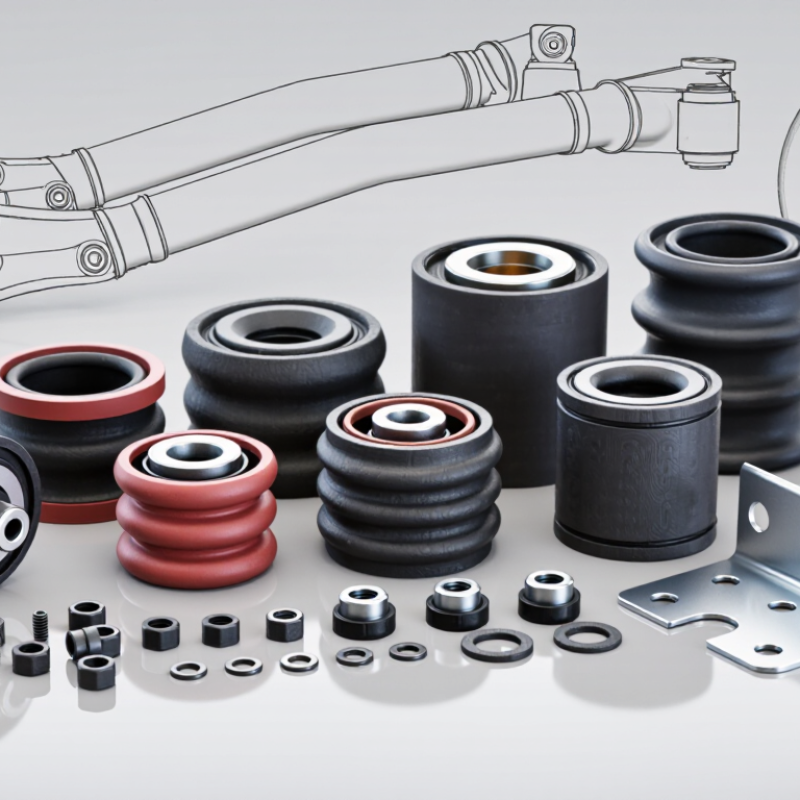
Define the Function and Operating Conditions of Rubber Bushes
How to Choose the Right Rubber Bushes?
Define the Function and Operating Conditions of Rubber Bushes
A rubber bush is not simply a spacer. It controls movement, reduces vibration, and limits metal-to-metal contact. Start by defining its job. Is it supporting a pivot, absorbing shock, or isolating continuous vibration? Each function requires a different stiffness, shape, and bonding method.
Measure the real operating conditions. Record static load, impact load, movement angle, frequency, and temperature. A suspension bush may face repeated twisting, while a machine mount may experience thousands of small vibrations each hour. Oil, water, dust, and road salt can also change rubber performance. According to ISO 815-1, compression set testing evaluates how rubber recovers after prolonged compression. Poor recovery can create looseness over time.
Material selection needs evidence, not habit. Natural rubber offers strong resilience, while synthetic compounds may resist heat, oils, or ozone better. The International Rubber Study Group’s 2024 industry report places global natural rubber production near 15 million tonnes annually. This scale does not guarantee suitability. Supply conditions can also shift with weather and energy costs.
Check hardness with the expected load. Too-soft rubber may bottom out. Too-hard rubber may transfer vibration into the frame. Small details matter. Bore clearance, sleeve alignment, and installation angle can change service life. A tidy calculation may still mislead if field loads are ignored. Prototype testing under real temperature and contamination is often the wiser step.
Evaluate Quality, Standards, and Expected Service Life
How to Choose the Right Rubber Bushes?
A quality rubber bush starts with the correct application data. Check load, movement, temperature, moisture, chemicals, and installation space. A bush that feels firm by hand may still be unsuitable under repeated vibration. Review hardness, tensile strength, elongation, and compression set. These figures explain performance better than appearance alone. Dimensions and tolerances should match the drawing, not an approximate sample.
Standards improve confidence, but they do not guarantee a long service life. Ask for material classification, batch records, inspection reports, and relevant test methods. Standards such as ASTM D2000 or ISO-based quality systems can support consistent production. For demanding environments, request testing for ozone, heat ageing, fluid resistance, and dynamic fatigue. Check whether the test conditions resemble real operation. They often do not. That difference needs careful judgement.
Tips: Inspect the rubber for cracks, trapped air, uneven bonding, or flashing. Confirm metal surfaces are clean and corrosion-resistant. Avoid forcing a bush into position with excessive tools. Misalignment can shorten its life quickly. Keep installation records, including torque, temperature, and press-fit dimensions. Field experience shows that small assembly errors often cause early failure. A supplier should explain expected service life in cycles, hours, or operating conditions, rather than making a vague “long-lasting” claim. Ask difficult questions. Good documentation makes the answer easier to trust.
How to Choose the Right Rubber Bushes?
Evaluate material quality, relevant test standards, operating conditions, and expected service life before selecting a rubber bush.
The chart shows typical service-life ranges for rubber bushes used in different applications under normal operating conditions. Actual life depends on rubber compound, load, temperature, ozone, moisture, installation quality, alignment, and maintenance. For quality verification, commonly referenced methods include ISO 37 for tensile properties, ISO 815 for compression set, ISO 1431 for ozone resistance, ISO 4662 for dynamic fatigue, and ASTM D2000 for rubber material classification.
Plan Proper Installation, Inspection, and Replacement Practices
How to Choose the Right Rubber Bushes?
Proper installation begins with accurate identification. Check the original dimensions, hardness, sleeve design, and operating temperature. ASTM D2000 provides a useful framework for comparing rubber compounds and performance requirements. Do not select a bush by appearance alone. Small differences matter.
Clean the housing before installation. Remove rust, grit, and old rubber fragments. Press the bush in squarely, using the correct support tools. Never strike the rubber directly with a steel hammer. Tighten fasteners at the manufacturer’s specified ride height, not with the suspension hanging. This prevents unwanted preload and early tearing. I have seen otherwise good bushes fail because this step was rushed.
Inspection should cover cracks, swelling, separation, and uneven movement. Look for polished metal around the sleeve. It may indicate excessive movement. The UK Driver and Vehicle Standards Agency’s 2023–24 MOT data places suspension defects among recurring failure areas, affecting roughly one in ten failed tests. That figure deserves attention. Replacement should consider age, contamination, load, and driving conditions, not mileage alone. ISO 16750 environmental testing also highlights temperature, moisture, and vibration as important durability stresses. A fixed replacement interval is convenient, but often wrong. Record the installation date and inspect again after the first few hundred kilometres. Small noises should not be ignored.