Top 10 Open Display Fridge Manufacturers Worldwide
An Open Display Fridge can make fresh food easier to see and reach, but its performance depends on more than a bright display. Airflow matters. So do temperature consistency, lighting, energy use, cleaning access, and the fit between cabinet design and store layout. A case that looks elegant under showroom lights may behave differently beside a busy aisle, where doors open nearby and warm air moves constantly.
For a practical engineering lens, refrigeration researcher Ian Bell’s systems-focused work offers a useful reminder. Editorial paraphrase, not a verbatim quotation: “Judge cooling equipment by stable performance, not appearance alone.” That principle helps frame this guide to the Top 10 Open Display Fridge Manufacturers Worldwide. It directs attention toward measurable specifications, service support, and documented operating conditions—not just polished product images or broad efficiency claims.
The manufacturers compared here serve different markets and applications. Some focus on modular supermarket cases; others offer compact units for cafés, convenience stores, or specialist food retail. Still, rankings have limits. Product availability, configuration, and performance can vary by model and region, and published specifications do not capture every store condition. Treat this list as a starting point, then verify the details that matter for your site.
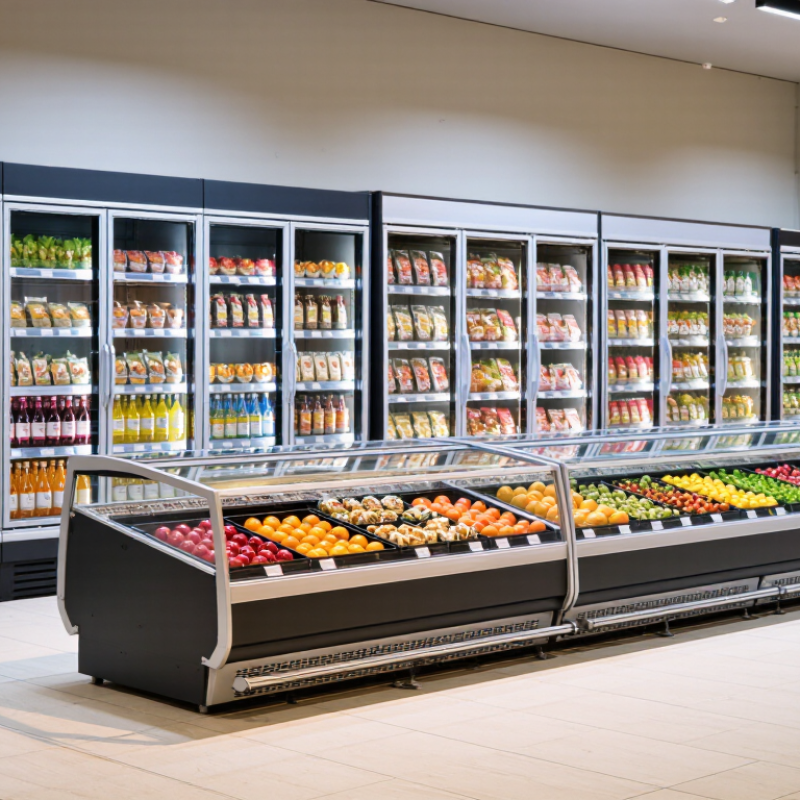
How Open Display Refrigerators Work and Serve Retail Environments
An open display refrigerator keeps products visible while maintaining a chilled zone across the shelves. An evaporator removes heat, and fans move cooled air through the cabinet. At the front, a moving air curtain separates the cold interior from warmer store air. Air returns through a grille, then circulates again. In practice, that curtain is not a solid wall. Nearby doors, aisle drafts, and poorly arranged products can disrupt it.
The U.S. EPA’s ENERGY STAR guidance for supermarkets reports that refrigeration can account for nearly 40% of a store’s energy use.
That figure helps explain why case design and daily operation matter.
Staff should avoid blocking return grilles with cartons, and should keep products within marked loading lines. Night covers, where fitted, can reduce heat entering the case after closing. Small details count. Defrost cycles, dirty coils, and leaking door seals can also affect performance.
The U.S. Department of Energy’s commercial refrigeration guidance highlights regular maintenance as part of efficient equipment operation.
Still, a tidy display does not prove a case is running well; temperature checks and service records reveal more. A cold aisle may look effortless, but the airflow behind it needs attention.
Criteria for Comparing Open Display Fridge Manufacturers
Comparing open display fridge manufacturers requires more than checking cabinet dimensions and cooling capacity. Compare energy use under the same test conditions, usable shelf area, temperature consistency, and recovery after frequent restocking. The International Institute of Refrigeration’s 2023 information note estimates that refrigeration and air conditioning account for about 20% of global electricity consumption. That makes energy performance a practical purchasing criterion, not just a specification-sheet detail. The U.S. Department of Energy’s commercial refrigeration test procedure provides a standardized basis for measuring energy consumption; request test results and confirm the model was assessed under comparable conditions. Cold air spilling onto the aisle matters.
Look closely at airflow design, anti-condensation features, defrost cycles, lighting, and access to replacement parts. Ask for temperature-mapping results across the top and bottom shelves, not only one sensor reading. Check performance at the store’s expected ambient temperature and during busy periods. A polished display may still have uneven cooling. I would also compare warranty terms and technician response times; these are easy to overlook until a unit is down.
Tips: Ask each manufacturer for measured daily energy use, temperature-uniformity data, and service-part availability. Compare like with like. A short in-store trial can reveal fogging, warm shelf edges, or airflow that disturbs nearby shoppers.
Profiles of Ten Leading Manufacturers Worldwide
These ten profiles examine leading open display fridge manufacturers through practical criteria: product range, temperature stability, energy use, customization, and after-sales support. The focus is not a league table. A supermarket buyer may care more about a nearby service network than a polished catalogue. In a busy aisle, stable temperatures and clear sightlines matter; so do shelves that can be cleaned without awkward gaps. Details like these reveal how manufacturers address daily operating conditions.
Market figures provide context, but not a direct ranking. Grand View Research valued the global commercial refrigeration market at USD 36.2 billion in 2023 and projected 5.1% annual growth through 2030. That category is broader than open display fridges, so the figure should not be treated as segment-specific. The UNEP-led Global Cooling Watch 2023 report also warned that cooling demand could more than triple by 2050 under current trends. Efficiency therefore deserves close attention in each profile, alongside cabinet design, controls, and refrigerant strategy. Still, published specifications do not always match shop-floor performance. That gap deserves scrutiny. Real results depend on installation, maintenance, ambient heat, and how often staff restock the case.
Regional Markets and Product Specializations
Regional demand shapes open display fridge design. In Europe, retailers often prioritize low-energy cases, LED lighting, night blinds, and heat recovery. In North America, larger supermarkets favor long multi-deck runs for dairy, drinks, and ready meals. Across parts of Asia-Pacific, compact footprints and strong humidity control matter in dense, warm urban stores. These are broad patterns, not fixed rules. Store format can matter as much as geography.
The International Energy Agency’s 2018 report, The Future of Cooling, projects that global energy demand for space cooling could more than triple by 2050. That is not a forecast for display fridges specifically, but it highlights why efficient compressors, airflow, and heat rejection deserve attention. In tropical stores, warm, moist air can quickly fog shelves or strain cooling performance. Small details matter.
Product specialization separates suppliers: vertical multideck cases suit packaged goods, while open island cases make frozen products easier to reach. Produce displays need careful airflow to limit drying; meat cases require stable temperatures and clear visibility. UNEP’s 2023 Global Cooling Watch also projects cooling demand will more than triple by 2050. Yet open cases expose products to aisle air, so efficiency claims need real-store testing. That gap is easy to overlook.
Factors to Consider When Choosing a Manufacturer
When comparing open display fridge manufacturers, look beyond cabinet size and quoted price. Ask for temperature-mapping results under realistic store conditions, including a fully loaded shelf and frequent customer access. A unit may cool evenly during a factory test but behave differently in a warm, busy aisle. Request clear details on airflow, defrost cycles, and recommended product loading. Small details matter.
Check the compressor, fan, lighting, and control components, then ask how quickly replacement parts can be supplied. A bright display is useful, but glare on the glass can make labels harder to read. Request energy-use data for the model and configuration you plan to buy, not a loosely comparable unit. Visit an operating installation if possible; listen for fan noise and look for condensation near the glass. Ask about cleaning access, staff training, warranty terms, and service coverage in your region. No checklist removes every compromise. I would also compare written responses, since vague answers may signal weak follow-through, though they do not prove poor product quality.
Top 10 Open Display Fridge Manufacturers Worldwide — Factors to Consider When Choosing a Manufacturer
Refrigerant Global Warming Potential (GWP100)
Refrigerant choice is one factor to assess when comparing manufacturers. Lower GWP values indicate lower climate impact per unit of refrigerant released; they do not measure a complete fridge’s lifecycle emissions or overall performance. Values shown are from Annex I of EU Regulation No 517/2014.