Get A Free Quote

China Top Inflatable Santa Claus Manufacturers and Suppliers

An Inflatable Santa Claus can turn a quiet shop entrance or warehouse display into a bright seasonal landmark. Yet a convincing design depends on more than a smiling face. Fabric weight, seam placement, fan access, anchor points, and printed colors all affect how the figure looks and performs outdoors. Small construction choices matter. They can also be hard to judge from a product photo alone.

Design researcher Don Norman observed, “Good design is actually a lot harder to notice than bad design, in part because good designs fit our needs so well that the design is invisible.” That idea offers a useful lens for comparing China’s manufacturers and suppliers. A well-made Santa should inflate evenly, stand securely, and remain easy to pack away after the season. Buyers should look for clear product specifications, realistic production timelines, material details, and responsive communication—not just polished catalog images. Ask for close-up photos of seams and electrical connections. Request samples or inspection records when practical. No supplier is perfect, and one overlooked detail can become a real headache. This guide introduces leading options and practical questions to help buyers assess product quality, customization, and service with care.
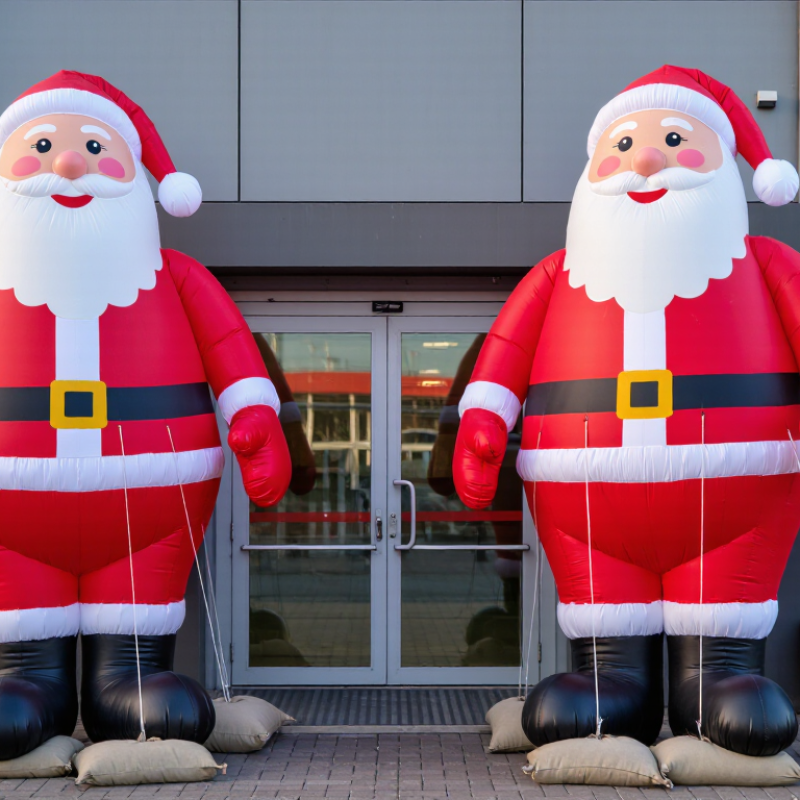
China Top Inflatable Santa Claus Manufacturers and Suppliers

What Inflatable Santa Claus Products Are and How Their 1–6 m Sizes Are Classified

An inflatable Santa Claus is a sewn fabric figure that takes shape when an electric fan fills it with air. Many models include internal lighting, while outdoor versions use ground stakes and tethers to steady the body. Size classifications usually refer to assembled height, measured from the ground to the highest point of the hat. They are practical sales categories, not a universal technical standard.

A 1–2 m figure suits a porch corner or small indoor display.

At 2–3 m, Santa can stand beside a doorway, but check the entrance clearance and base footprint.

Models from 3–4 m need more open space and stronger anchoring.

The 4–6 m range is intended for broad lawns or commercial displays; a tall figure also catches more wind.

A neat size chart can still mislead. Hat height, pose, and inflated shape affect the real footprint.

For seasonal context, the National Retail Federation’s 2024 holiday forecast projected U.S. November–December retail sales of $979.5–989 billion, up 2.5–3.5% year over year. That broad retail estimate is not an inflatable-Santa sales figure, but it shows the scale of seasonal purchasing.

Before choosing a height, measure the display area, ceiling or overhead clearance, and available anchoring points. Also check the product’s stated dimensions after inflation; packaging size tells you little about its displayed scale.

Fabric and Construction: Common 210D–600D Polyester and PVC Options

For an inflatable Santa, fabric choice affects weight, handling, and resistance to wear. 210D polyester is relatively light and can suit smaller displays or sheltered porches. It may be less forgiving when repeatedly packed, rubbed, or exposed to sharp edges. That matters outdoors. Options around 300D–600D generally feel more substantial, but denier alone does not guarantee durability. Weave density, coating quality, stitching, and reinforced stress points all count. Check the fan opening, anchor loops, and seams near the arms; these areas take repeated strain.

PVC may be used as a film or as a coating on polyester. A PVC-coated fabric combines a textile base with a water-resistant surface, while unbacked PVC can feel less breathable and may become stiff in cold conditions. Actual performance depends on thickness and construction, so ask suppliers for material specifications rather than relying on “heavy duty” wording. Request a sample, bend it gently, and inspect the coating for cracks or peeling. I would not assume the thickest option is always best: heavier fabric can make a large figure harder to handle, and that trade-off deserves a closer look.

China Top Inflatable Santa Claus Manufacturers and Suppliers - Fabric and Construction: Common 210D–600D Polyester and PVC Options

Fabric option Typical construction Common characteristics Suitable considerations Specification checks
210D polyester Lightweight woven polyester, often finished with a PU or other coating. Lower fabric bulk than heavier denier options; compact and relatively easy to pack. Decorative inflatables where low packed weight is a priority and exposure conditions are suitable for the fabric and finish. Ask for coating type, water-resistance details, seam construction, and care instructions.
300D polyester Woven polyester with a coating or finish selected for the intended use. A midweight fabric option; actual strength and water resistance depend on yarn, weave, coating, and sewing. A potential balance of packability and fabric robustness for seasonal display products. Compare fabric weight, coating, colorfastness, and construction rather than denier alone.
420D polyester Medium-to-heavier woven polyester; coated versions are commonly used where added fabric durability is desired. Generally uses a heavier yarn than 210D polyester, but denier by itself does not specify finished-fabric weight or performance. Consider for designs with more handling or where the product specification calls for a more substantial fabric. Check tear and tensile test results, coating adhesion, seam strength, and repair method.
600D polyester Heavier woven polyester, often available with PU or PVC-type coatings. Typically bulkier than lower-denier polyester; finished performance varies with weave, coating, and manufacturing quality. May suit products for which a heavier cover is preferred, subject to the inflatable’s design and intended environment. Confirm packed weight, flexibility, coating specification, and whether the fabric is designed for the stated use.
PVC-coated polyester Polyester base cloth laminated or coated with polyvinyl chloride (PVC); often specified by finished weight or thickness. The coating can provide a water-resistant surface; flexibility, weight, and cold-weather behavior depend on the formulation and construction. Consider when a coated, more robust material is required; verify that the product design and blower system are compatible. Request finished fabric weight or thickness, temperature guidance, seam method, and applicable compliance documents.
Uncoated or lightly finished polyester Woven polyester with no substantial waterproof coating or with a light surface finish. Breathability and air retention depend on the fabric and inflatable design; it should not be assumed to be waterproof. May be used in fan-powered designs that rely on airflow through the fabric, depending on the product construction. Clarify whether the inflatable is sealed-air or continuously fan-inflated and review outdoor-use instructions.
Note: Denier describes the linear density of yarn, not the finished fabric’s weight, thickness, strength, or waterproof rating. Polyester denier ranges and PVC-coated fabric specifications are not directly interchangeable. Verify the complete material specification and test data for each product.

Blowers and Lighting: 220 V/50 Hz Power and IEC 60529 IP Ratings

When evaluating inflatable Santa Claus manufacturers and suppliers in China, check blower and lighting specifications before comparing appearance or price. Products intended for 220 V/50 Hz power should state this clearly on their rating labels. Ask for the plug type, wattage, and operating current of each component. Small detail, big difference. A blower running for hours may draw more power than expected, especially when several decorations share one circuit. Confirm the supplier’s recommended electrical setup, and do not treat a product photo as proof of compatibility.

For outdoor use, review the IEC 60529 IP rating for the blower housing, lights, and cable connections. The first IP digit concerns solid particles; the second concerns water ingress under specified test conditions. An IP rating is not a blanket promise that every seam or connector stays dry. Not waterproof by default. Keep plugs and joints raised from wet ground, and follow the manufacturer’s setup instructions. Request test documentation when available. One shortcoming in many listings is vague wording such as “weather resistant”; ask what component was tested and under which conditions.

How China Manufacturers Handle OEM Design, Sampling, and Quality Control

For inflatable Santa projects, strong OEM work starts with a precise brief: finished height, fabric type, fan voltage, lighting layout, packing size, and intended display conditions. Small details matter. China-based manufacturers can turn sketches into CAD drawings and sewn prototypes, but buyers should approve color, seams, airflow, and stability before mass production. One sample is not enough when the design includes several fabric panels or lighting zones.

Demand data helps explain the pressure to prepare early. The National Retail Federation’s 2024 holiday forecast put U.S. seasonal sales at $979.5–$989 billion, up 2.5%–3.5% from 2023. The U.S. Census Bureau reported fourth-quarter 2024 e-commerce sales of $300.2 billion, or 17.1% of total retail sales. These figures describe broad retail, not inflatable décor specifically; they still underline why late samples and weak packaging can cost a selling window.

Quality control should follow the product through each stage. Factories can check fabric cutting, seam strength, fan operation, lighting, and packed-carton dimensions, then record defects and corrective actions. A timed inflation test on a sample unit can reveal leaks or unstable airflow. It is useful, not perfect. Batch variation can remain, so buyers should agree on inspection criteria and request dated photos or test records before shipment.

How to Assess Suppliers: CE, RoHS, Lead Times, MOQs, and Export Support

Assessing an inflatable Santa Claus supplier starts with product-specific evidence, not a certificate image. Request the CE declaration and check that its model details match the item being quoted. For RoHS, confirm which electrical components and materials the documentation covers. Scope matters. A file for a blower may not cover the full decoration. Ask for clear product photos, fabric specifications, and test records where relevant, then compare them with your intended market’s requirements.

Lead times need more detail than “ready in 30 days.” Separate sample approval, production, inspection, and shipping estimates. Ask what happens if artwork changes or peak-season orders delay materials. Confirm the shipping method and whether the quoted schedule includes export preparation. Small details count: a missing plug specification can trigger rework. Paperwork can look tidy. It may still be incomplete.

Check MOQs by size, design, and packaging, not just by order. A low minimum may apply only to one standard color. Request a written breakdown of unit price, cartons, spare parts, and any sample charges. Export support should include packing lists, commercial invoices, and timely responses to document questions. Keep communication in writing. One useful question is, “Which documents will you provide for this exact model?” Supplier answers are not always perfect; compare them against your checklist before paying a deposit.

China Inflatable Santa Claus Supplier Assessment

Illustrative evaluation of key supplier-check dimensions. Scores are example ratings, not verified data for specific suppliers.

Use the same 1–5 rating scale when comparing suppliers: verify applicable CE and RoHS documentation, confirm production and shipping lead times, clarify minimum order quantities, and assess export-document and logistics support. Request current evidence directly from each supplier.

crossmenu linkedin facebook pinterest youtube rss twitter instagram facebook-blank rss-blank linkedin-blank pinterest youtube twitter instagram